
Dec13–142026
Geminids
Best time: From about 10 PM through the pre-dawn hours.
Look broadly across the sky; Gemini rises in the east during the evening.
Active Dec 4–Dec 17 · Peak night guidance, not a guaranteed burst.LOCAL · TWIN OAKS, JACKSON, MISSOURI
Look up from Twin Oaks. Plan an evening under the stars and share what you see.
TONIGHT · Monday, Nov 23
Start after sunset, give your eyes time to adjust, and find a spot away from porch and street lights.
Moonrise 3:43 PM
Moonset 5:44 AM
Approximate local times. Moonlight can wash out faint stars, while a bright Moon makes a great photo subject.
Check cloud cover, rain, and wind in the local forecast. Darkness times describe sunlight, not clear skies or moonlight.
All times Central. Sunset and twilight are calculated for Twin Oaks; moon phase and rise/set times are estimates.
Open Stellarium’s interactive sky map ↗
Set the sky map location to Jackson, Missouri. About twilight times ↗
A REASON TO STEP OUTSIDE
Times and directions for our neighborhood. Clear skies and an open view still matter.
SHOOTING STARS & FIREBALLS
Best time: From about 10 PM through the pre-dawn hours.
Look broadly across the sky; Gemini rises in the east during the evening.
Active Dec 4–Dec 17 · Peak night guidance, not a guaranteed burst.Best time: After midnight until morning twilight.
Face away from bright lights and take in as much sky as possible.
Active Dec 17–Dec 26 · Peak night guidance, not a guaranteed burst.Best time: After midnight until morning twilight.
Face away from bright lights and take in as much sky as possible.
Active Dec 28–Jan 12 · Peak night guidance, not a guaranteed burst.Best time: After midnight until morning twilight.
Face away from bright lights and take in as much sky as possible.
Active Apr 14–Apr 30 · Peak night guidance, not a guaranteed burst.Best time: Late evening through the early morning.
Look broadly across the sky; occasional bright fireballs are possible.
Active Oct 20–Dec 10 · Peak night guidance, not a guaranteed burst.Best time: After midnight until morning twilight.
Face away from bright lights and take in as much sky as possible.
Active Nov 6–Nov 30 · Peak night guidance, not a guaranteed burst.No telescope needed. Bring a reclining chair and give your eyes 20–30 minutes in the dark. Moonlight and nearby lights reduce the number you will see; shower rates are not a local guarantee.
A MOVING POINT OF LIGHT
Look for a steady bright point moving across the sky without flashing aircraft lights. Times below cover the predicted visible part of each pass.
Low on the horizon — trees and houses may block this pass.
Low on the horizon — trees and houses may block this pass.
Calculated for Twin Oaks using CelesTrak orbital data and Skyfield. We require the ISS to be sunlit, the Sun at least 6° below the horizon, and the station at least 10° high. 0° is the horizon; 90° is straight overhead. Predictions can shift after orbit adjustments. Orbit epoch: Sun, Nov 22 · 10:53 PM CST.
Looking for the rows of Starlink satellites? Open Starlink Trains for dedicated train-viewing predictions →
SPACE WEATHER
Current geomagnetic guidance does not suggest a strong local viewing opportunity. Most aurora activity remains well north of Southeast Missouri.
Twin Oaks sightings are uncommon. Our low/elevated/watch labels are broad guidance based on geomagnetic activity, not NOAA visibility probabilities. Kp alone cannot confirm that the lights will be visible here.
6:00 PM–9:00 PM CST
Latest observed: 1.00 · 3:00 PM CST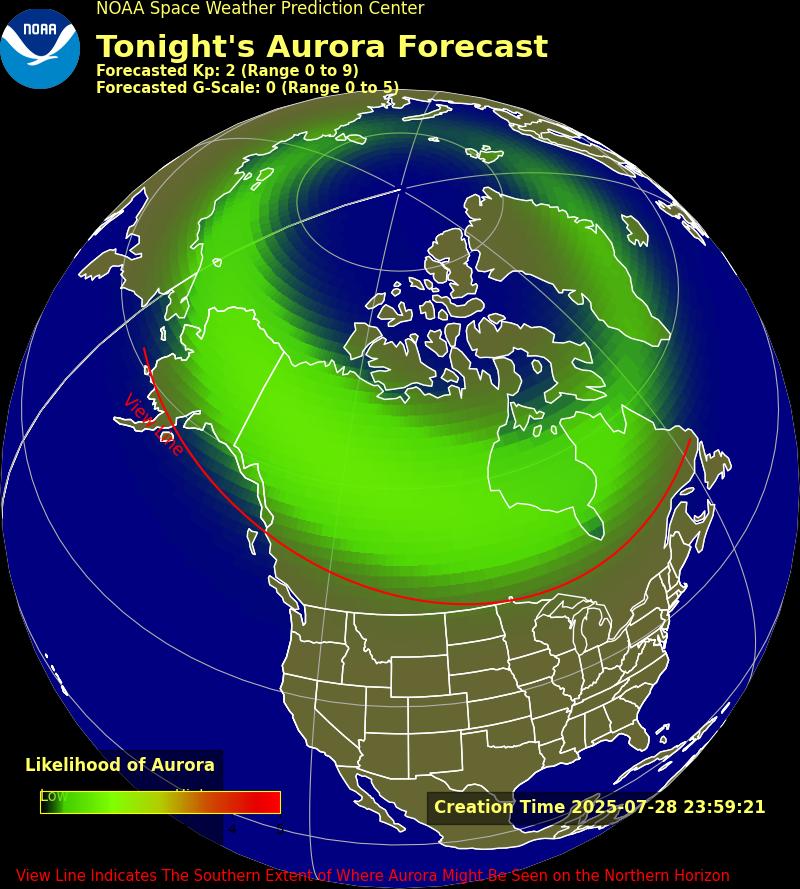
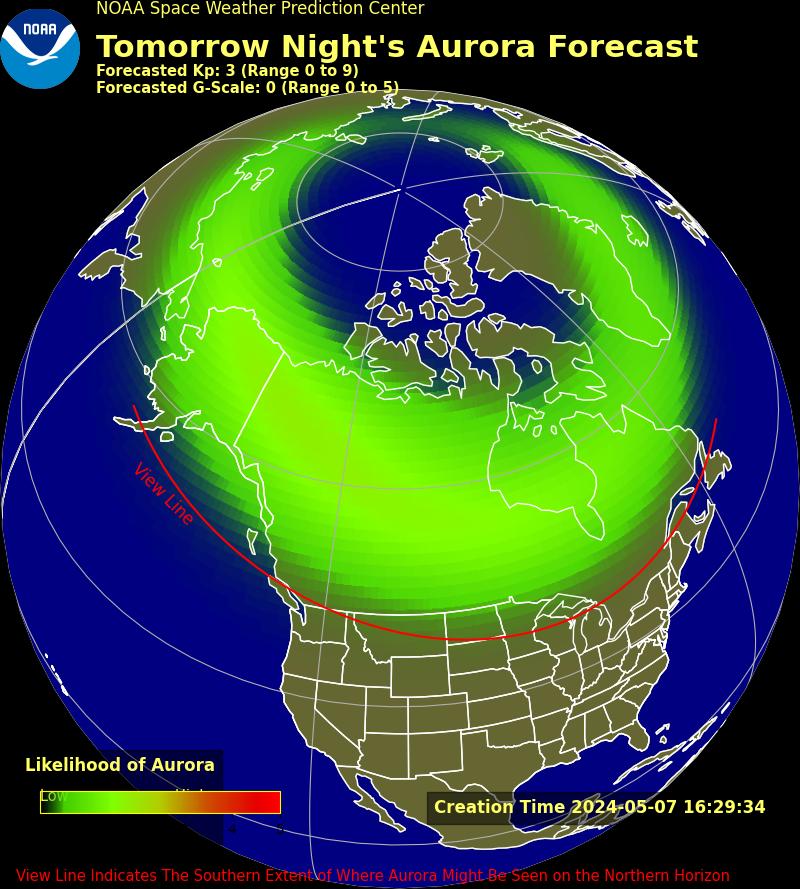
NOAA’s experimental maps show the forecast aurora region, not a guaranteed sighting boundary. Check the date printed on the image.
If activity rises, find a dark place with an unobstructed view north. A phone’s night mode may capture faint color that is hard to see by eye.
LOOK A LITTLE CLOSER
Look SE around 6:10 AM CST · 26° high
Tue, Nov 24
Viewing window: 5:10 AM–6:10 AM CST
Look for a very bright steady point.
Look S around 5:50 AM CST · 66° high
Tue, Nov 24
Viewing window: 12:30 AM–6:10 AM CST
Look for a steady point with a warm orange tint.
Look S around 5:40 AM CST · 66° high
Tue, Nov 24
Viewing window: 12:20 AM–6:10 AM CST
A bright steady point; binoculars may reveal its brightest moons.
Look S around 8:20 PM CST · 53° high
Mon, Nov 23
Viewing window: 7:14 PM–1:00 AM CST
Looks like a steady point to the eye; a telescope reveals its rings.
Approximate windows with the planet at least 15° above the horizon and the Sun at least 6° below it. Best time means the highest point during the remaining window; times are rounded to about ten minutes.
MORE DATES FOR YOUR CALENDAR
Mon, Nov 30 · 1:00 AM CST · Look E
About 1.2° apart, 28° above the horizon. A close-looking pairing in our sky, not physical proximity.Mon, Nov 30 · 6:20 AM CST · Look SSW
About 4.3° apart, 64° above the horizon. A close-looking pairing in our sky, not physical proximity.Tue, Nov 24 · 8:53 AM CST
A good photo subject, but its bright light hides fainter stars and meteors.Tue, Dec 8 · 6:51 PM CST
Nights around this date have less moonlight for meteor watching and faint stars.Wed, Dec 23 · 7:28 PM CST
A good photo subject, but its bright light hides fainter stars and meteors.THROUGH OUR NEIGHBORS’ EYES
Resident photos, reviewed before they appear.
Share the Moon, constellations, a meteor, or an evening sky over Twin Oaks.
Choose a photo to submit →Have a photo to share? Your name is optional. Email addresses stay private, and embedded location data is removed from uploaded photos.